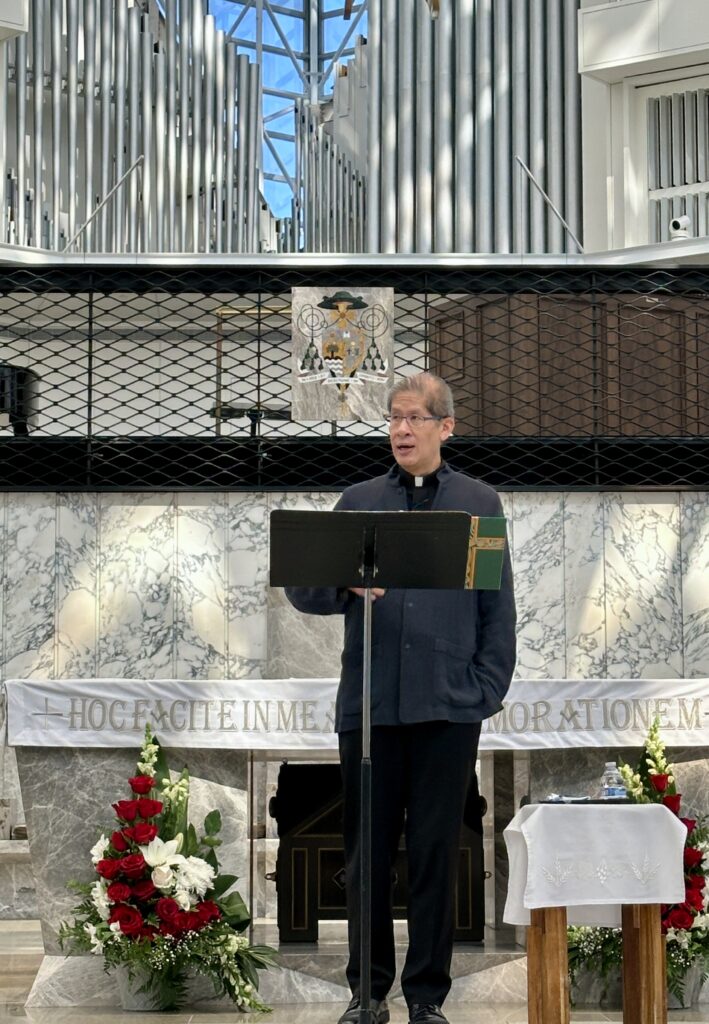
On Sunday, February 22, 2026, Fr. Ricky Manalo, CSP presented at the Los Angeles Religious Education Congress on the topic: “Toward a More Perfect Union: Finding Christ in a Time of Polarization” Take a sneak peak at some excerpts from his talk below:
I am a better American because I am Catholic;
I am a better Catholic because I am an American.
—Servant of God Isaac Hecker
So wrote Isaac Hecker, the founder of the Paulist Fathers, whose vision of faith and nation was
not one of conflict but communion. For Hecker, Catholicism and American democracy were twin
callings: one forming the conscience, the other shaping the context in which that conscience
would act.
Today, that harmony feels strained. The bonds that once held Church and nation in creative
tension are fraying under the weight of suspicion, tribalism, and mistrust. Yet Hecker’s words
still whisper a possibility: that the healing of our civic life from toxic polarization might emerge
alongside the renewal of a deeply divided U.S. Church. Perhaps these are not separate paths, but a shared pilgrimage toward communion.
Toxic polarization is among the most critical challenges of our time, not because they are
the only crises we face, but because they prevent us from responding meaningfully to all the
others. When social trust erodes and opponents are reduced to enemies, the conditions necessary for addressing even our most morally charged debates—such as abortion, immigration, and racial justice—begin to collapse, along with our shared pursuit of democracy, ecclesial reform, and the common good.
The Catholic Church in the United States stands at the crossroads of these forces—not
only as a microcosm of national tensions, but as a uniquely situated site for spiritual renewal.
These same forces deeply shape Catholic life. They now influence moral priorities, liturgical
styles, and attitudes toward Church leadership and teaching. As a result, many Catholics find
themselves sorted into ideological enclaves—within homes and workplaces, and even online and in the pews—where trust across difference frays and the shared imagination of the faith quietly erodes.
The polarization affecting the U.S. Catholic Church is not merely a matter of policy dispute or partisan loyalty. It is a deeply spiritual and relational rupture, shaping how Catholics imagine moral life, celebrate the sacraments, interpret tradition, and remain in communion amid difference. Within Catholic life, polarization is more than disagreement; it is the loss of our
capacity to remain in relationship, even amid difference, as one body in Christ. This crisis shows
up in hardened identities, ideological silos, and a weakening of trust—not only across society,
but within parishes, dioceses, and families. It damages relationships and wounds our capacity to
be Christ to one another.
Healing this crisis requires more than neutrality, policy, or tactical strategy. It demands a
renewal of the practices that make communion possible: encounter, discernment, reconciliation,
accompaniment, and witness. These are not abstract values. They are spiritual habits, deeply
rooted in our tradition, that form us for communion in a divided Church and world.
Talk Description:
Across our country, dioceses, parishes, families, and communities, divisive lines are being drawn: traditionalists versus progressives, Red versus Blue, and conflicts rooted in race, gender, and social class. We live in an era of toxic polarization, searching for meaning and Catholic resources that foster harmony and unity. This presentation offers a pastoral roadmap toward healing, reconciliation, and hope.